Know if you're ready to ship
— before anyone asks.
Hawzu connects requirements, execution, and defects into one execution-first
platform — with release-readiness scoring, sign-off reports, and analytics that
turn test data into decisions. And you can just ask: Oracle answers questions
about your project in plain English.
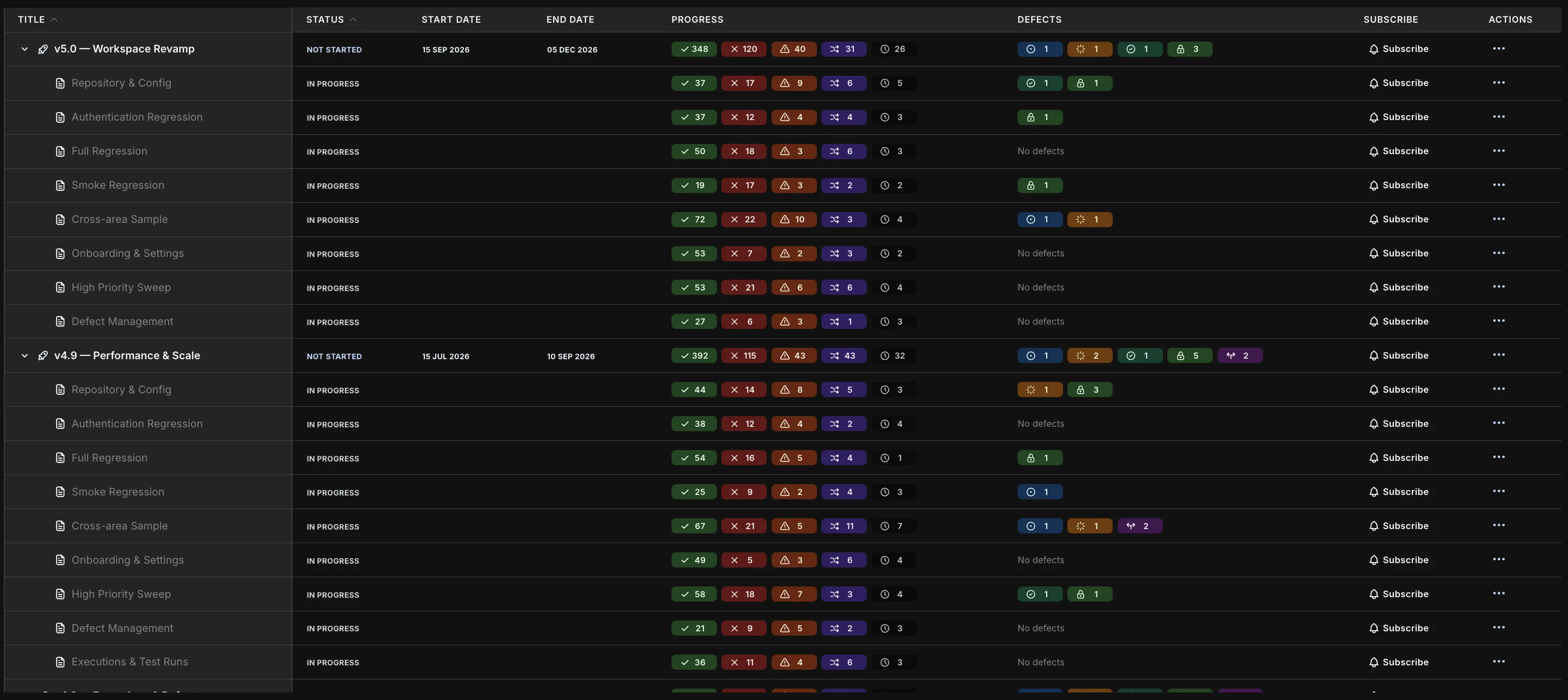
Every release and its executions at a glance — progress, defects, and ownership in one view.
The problem Hawzu solves
Traditional test case management creates activity,
but very little clarity. Hawzu takes a different approach.
The Problem
Teams run thousands of tests and still can't tell if they're ready to ship
Executions scattered across releases, runs, and tools
Test cases authored carefully, but rarely traceable
Defects synced everywhere, but owned nowhere
Reports that look complete, yet explain very little
The Hawzu Approach
Execution-first.
Structured by design.
Executions are always anchored to releases
Test runs exist without corrupting reports
Requirements, tests, executions, and defects stay connected
Audit trails are preserved — not reconstructed
Quality intelligence
Ship on evidence, not gut feel
Every release gets a score, a verdict, and the one line that says which
bar it failed — so "are we ready?" stops being a conversation and starts
being a number you can check.
Release 2026.8.1Not ready
62/ 100
Quality70
Test Execution85
Defect Health20
Requirements60
✕
Blocker or critical defects are still open before release sign-off.
Same release, same number, every time — no AI involved.
Project Health Scorecard
The same treatment for the whole project, across five dimensions — Automation, Coverage, Execution, Quality and Defect Health.
Sign-off, written for you AI
An executive summary and risk list drawn strictly from the release's own metrics, exported as a Release or Execution sign-off PDF.
Which failures are real
Flaky-test detection sorts tests into Stable, Unstable and Flaky and flags probable breakages — so a red run is not automatically a blocker.
Govern
Roles, audit trails & integrations — across every stage.
Canon & Atlas
Hawzu knows your product — not just your test cases.
Two features sit under everything else: the documents that say how your product is
supposed to behave, and a map of what it's actually made of. Together they are why an
AI answer here has a source you can open and a shape you can reason about.
Canon
What the product promises
Your PRDs, specs, standards and exit criteria — the rules the AI writes against
Every generated test case names the document and section it drew on
Readiness judged against the criteria you wrote down, not a generic benchmark
Canon says what the product promises. Atlas shows what it's
made of. Everything downstream — generated tests, release calls,
what to retest — is judged against those two.
Record a Test Beta
Do the test once. Get steps and scripts.
The Hawzu Recorder Chrome extension follows a test you run once in the browser, and the
test case keeps it as readable manual steps and two scripts your own CI runs.
Readable steps
Click the "Sign in" button
The "Welcome back, Alice" heading is visible
For whoever runs it by hand, with your checks as expected results.
The code travels with every result as a report property.
Hawzu never runs the scripts. Your CI does, and each result lands back on
its test case by that code. When a page changes, fix the broken locator once in the Object
Repository, and every test case that uses it gets the new one.
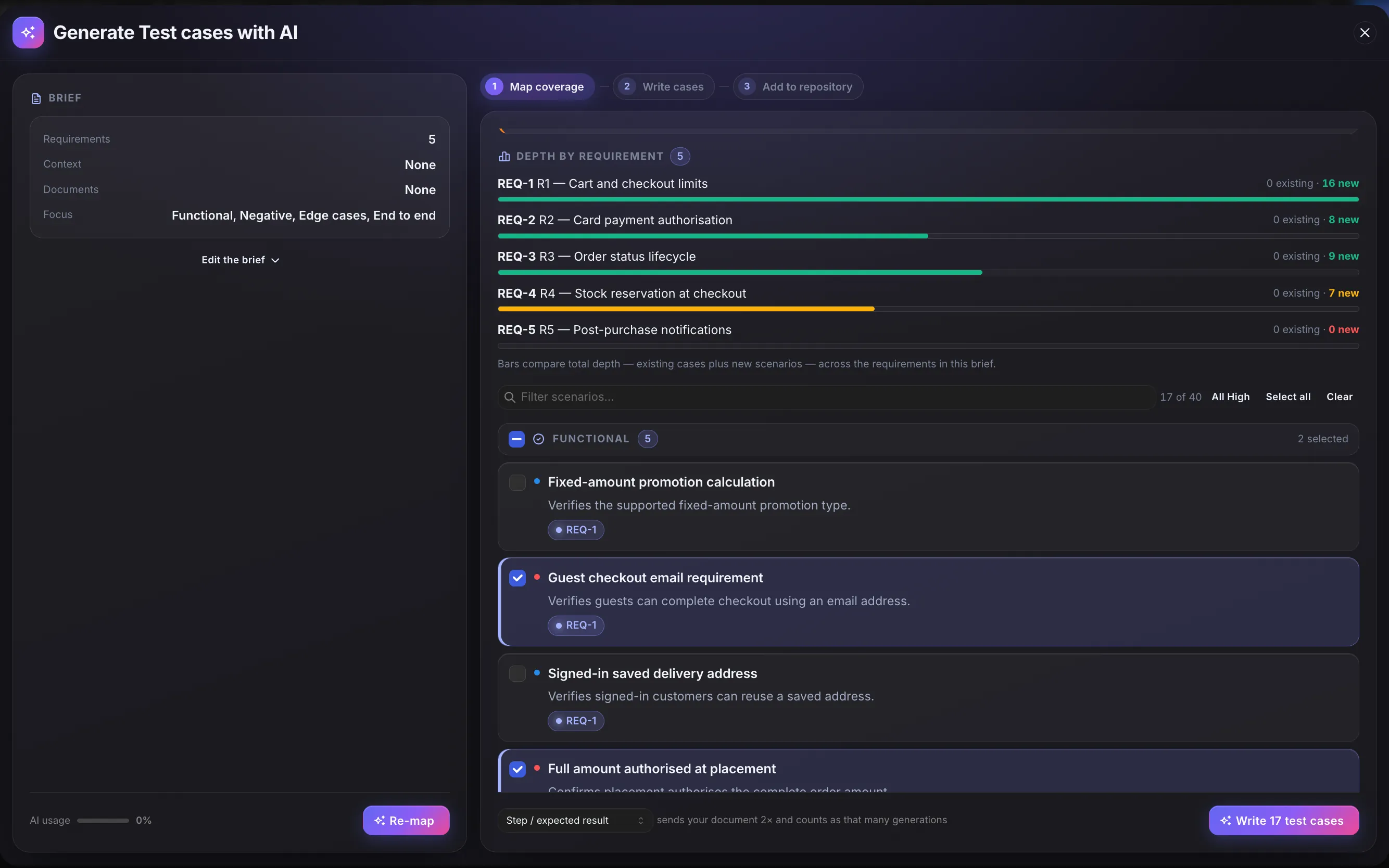
Generate test cases with AI.Give it a requirement, a spec, or a PDF and it writes full test cases with steps and expected results. It maps the scenarios first and names the requirements nothing was proposed for, so you see the gaps while they're still cheap to fix.
Track defects natively.Drag them across a Kanban board — swimlanes, WIP limits, and every drop a real update — or work the same defects as a table, one click apart. Linked to the failing step, with AI surfacing similar defects as you file. No Jira required.
Oracle is the AI inside Hawzu. Ask in plain English and it answers with the
matching records, a chart, an answer drawn from your own documents — or the
right form, open and ready. And it shows you exactly what it understood.
Automated test cases created in the last 10 days that have never been executed
Ask
Understood as
Automation status is Automated × Created on or after 2026-08-15 × Never executed × Never added to any run ×
18 test cases
TC-1042Checkout · apply promo code at basketHigh
TC-1108Login · SSO redirect returns to originMedium
…and 16 more
The matching records
A chart
An answer from your documents
The right form, open
One box. Oracle works out which of these your sentence asked for before it
works out the answer — you never pick a mode.
Observatory
See the quality behind every release
The questions you ask every week are already built. Pick one and Observatory
draws it, drops it on a dashboard, and keeps it current — dozens of ready-made
Smart Insights across coverage, automation, execution and defects, recommended
per project.
Is automation coverage improving?
Automation over time, by priority and severity
How is this release trending?
Execution pass / fail / blocked and release pass-rate trend
Where are defects piling up?
30d+14d7dNew
Defect aging and open load by assignee
Are we on pace to finish?
Execution velocity and burndown across the release window
Is every requirement covered?
74%
Test and defect coverage per requirement
Need a different view?
+
Build any chart with the custom chart builder — export to PDF or XLSX.
AI in Hawzu
AI that knows where to stop
Not a bolt-on chatbot. Hawzu's AI writes test cases from your requirements,
judges whether a release reads as ready, knows whether this bug has been
filed before, and answers questions about your project in plain English —
always working from your own data, and always showing what it read.
And every feature that uses AI says so. The readiness
score, the retest tiers, the chart picks and the flaky verdicts are
arithmetic and rules — reproducible, and the same twice. In QA, a number you
can't reproduce is worse than no number.
And in one place the AI is yours. Hawzu speaks MCP, so
Claude, ChatGPT or Cursor can read your test data from the editor you already
work in — read-only, never past what your own role can see, and running no
model of ours at all.
Hawzu is a modern test case management platform. Plan and organize test cases, run them, and track requirements, defects, and releases — with built-in analytics and AI across the whole testing lifecycle, in one place.
Who is it for?
QA and engineering teams who want a clean system of record for testing — whether you test manually, run your own automation, or both.
Do I have to use a specific automation tool?
Keep whatever you already run — Selenium, Playwright, Cypress, any framework. Hawzu reads JUnit, TRX, NUnit, Cucumber and Allure reports and maps every result onto your test cases. It manages and analyses your testing without owning your engine, so switching frameworks never means switching test tools. No script yet? Record the test once in Chrome and Hawzu keeps it as Playwright (TypeScript) and pytest + Selenium (Python) scripts you run like any other.
Can Hawzu run my CI pipeline?
Yes. Point a test run at a Jenkins job, a GitHub Actions workflow, or a GitLab CI pipeline and press Run — Hawzu starts the build, watches it, downloads the report it produced, and maps each result onto your test cases. Pipelines that already run on their own schedule can push to Hawzu instead. See how CI/CD automation works.
How does Hawzu know which test case an automated result belongs to?
By the test case code — stated in the report, or simply embedded in the test's name, like CHK-101 user can log in. Matching on names alone breaks the first time somebody renames a test, so the code always wins. Results that match nothing are recorded separately and never affect your pass rates or release readiness.
Can AI write my test cases?
Yes. Point it at a requirement, a pasted spec, or a PDF and it writes full test cases with steps and expected results. It also maps the coverage first — up to forty one-line scenarios grouped by risk lens, with the requirements nothing was proposed for named on screen — so you see the gaps and pick what's worth writing before it writes anything. Nothing is saved until you accept it. See how a run works.
How do you stop the AI inventing behaviour that isn't in our product?
Give it your own documents. Canon is the set of specs, PRDs, standards and exit criteria the AI writes from — add a document and every generated test case names the document and section it used, so a reviewer checks a claim in seconds instead of working it out again. It's on by default and can be turned off for a single run. Canon reads documents you supply (PDF, Word, Excel, CSV, Markdown, text) — there is no crawler and no wiki connector — and when nothing in it matches a topic it says so plainly rather than filling the gap. See how Canon works.
Can I just ask Hawzu a question about my project?
Yes — that's Oracle. Type it the way you would say it, like automated test cases created in the last 10 days that have never been executed, and it answers with the matching records, a chart, an answer drawn from your own documents, or the right create form opened ready for you. Every condition it applied is printed above the answer in plain terms — "the last 10 days" shown as the actual date — and taking one away re-runs the answer instantly without using AI again, so correcting it is free. It reads your permissions from the same rules that guard each screen, and it never sees the contents of a record: it is shown what your fields are called and the values they hold, not your test case titles or defect descriptions. Meet Oracle.
We changed one service — how do we know what has to be retested?
Ask Atlas. It keeps a curated map of your application — areas, screens, behaviours, the routes between them and the journeys people actually walk — built from your test folders and the requirements you link, and optionally drafted from Canon for you to review. Pick the part that changed and it returns a worklist in three tiers, where every test case states why it is listed: it sits on the changed part, it's on a critical journey, or it covers a linked requirement. It's ranked in tiers rather than scored, because a number nobody can predict is worse than a bucket they can. Atlas does not read your code. See an impact answer.
Do I need Jira to use Hawzu?
Hawzu stands on its own — requirements and defect tracking are native, with a full Kanban board and a lifecycle linked to the failing step. If your team already lives in Jira, GitHub, GitLab, Azure DevOps or Linear, connect them: file the issue in your tracker as you raise the defect, or link one that already exists, and the defect shows its live status either way.
Can I work defects on a Kanban board?
Yes — the board is the default view for a project. Drag defects between columns, group by status, assignee, severity, priority, release, or your own dropdown field, split it into swimlanes, and cap a column with a WIP limit that warns or blocks. Every drop is a real update, with the history, notifications, and tracker sync to prove it — and the same defects are one click away as a sortable table. See the defect board.
Is there really a free plan?
Yes, and it is the whole product — five people, three projects, no credit card and no seat minimum. Nothing is held back for a higher tier: the paid plans give you more people, more storage and more history, never more features. Growth is $20 per member per month billed yearly when you outgrow it.
Switching from another tool — can I migrate my test cases?
Yes, and you run it yourself. The import wizard takes TestRail, Zephyr, QASE and Excel/CSV exports directly — map your columns, preview a sample, and it rebuilds your folder hierarchy as it goes. Coming from something else, send us the export and we'll map it with you. Nothing is a big-bang migration and no history is lost. Talk to us about migrating or compare Hawzu.
Is my data secure?
Role-based access control, audit logs, and scoped access tokens are built in, and your test data stays yours. See our Security page for details.
Independent · founder-led
Why we built Hawzu
Every test management platform we tried was a bug tracker with test cases bolted on.
Testing deserved better than that. So Hawzu is built the other way round: requirements,
repository, executions, defects, releases, analytics and AI are one system, and the
connections between them are the product.
We're independent, we answer to the teams who use this rather than to a board, and
every plan is the whole product — nothing held back for a higher tier. Tell us what's
missing and it goes on the roadmap — that access is the part you can't buy later.
— The team at Snoowl
Stop guessing whether you're ready to ship
Create a free workspace in minutes — no credit card required. Score your first
release, trace every requirement, and see the quality behind it. Or explore the
docs to see how Hawzu connects it all.